
Behind the Scenes of a DairyCattle Genetic Evaluation:Making Fair Comparisons
Add Your Heading Text He
In Article 1, we learned that phenotypes are the foundation of every genetic evaluation. However, an animals’ performance record on its own does not provide the full picture. A common way to think about performance is: Phenotype = Genetics + Environment. In simple terms, what we observe in an animal is influenced by both its genetics and the environment in which it is raised and managed. The challenge for a genetic evaluation is to separate the environmental influences from an animal’s genetic potential so that animals can be compared fairly.
Accounting for the Environment
Understanding the environmental influences that contribute to the phenotype we observe is a major challenge for a genetic evaluation. A cow’s performance is influenced by many factors throughout her life. For example, the amount of milk a cow produces can be affected by herd management, feed quality, season, parity, age at calving, milking frequency, housing, weather, or stage of lactation. Disease risk, on the other hand, may be influenced by pathogen exposure, vaccination status, pen density, bedding, ventilation, and the skill of the person recording the event. When developing a genetic evaluation, we therefore try to account for as many of these non-genetic influences as possible.
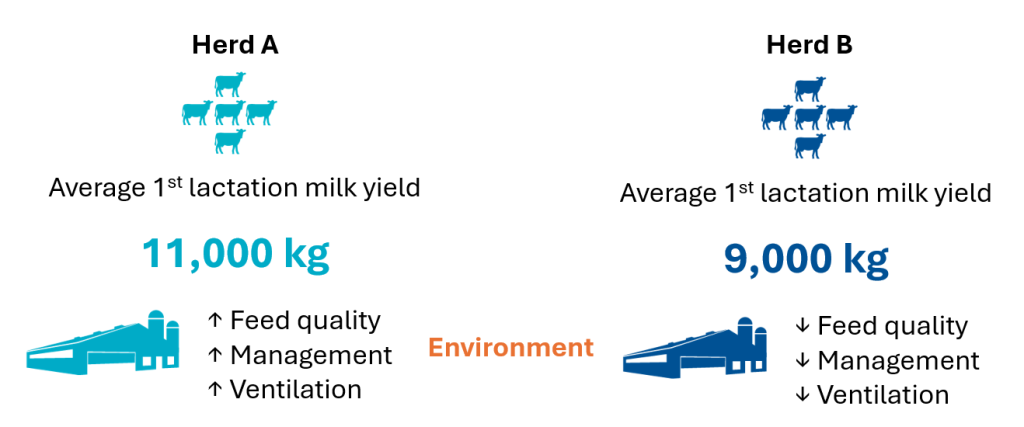
To account for environmental influences, genetic evaluations compare animals with others that had a similar opportunity to perform, known as a contemporary group. For example, suppose Herd A has an average first-lactation milk yield of 11,000 kg, while Herd B averages 9,000 kg. The difference between cows in these herds may be influenced by several environmental or management related factors. To help account for these differences, cows could be grouped by herd, year, season, or parity for a particular trait. Cows in Herd A would therefore primarily be compared together, rather than directly with cows experiencing the very different environment of Herd B. The goal is to put animals on as level of a playing field as possible. The evaluation estimates how much of an animal’s observed performance can be explained by known environmental factors. Once these influences are accounted for, the remaining information provides a clearer indication of the genetic differences among animals.
Without these considerations, animals raised in more favourable environments, such as Herd A, could appear genetically superior simply because they had a better opportunity to perform. Accounting for environmental effects helps ensure that a breeding value reflects what an animal is expected to pass on genetically, rather than simply how well it performed under a particular set of conditions. This is one of the most important differences between a genetic evaluation and a simple performance ranking
Estimating Genetic Potential
Once environmental influences have been accounted for, attention shifts to the genetic component of the equation (P= G+E). The objective is to determine how much of the remaining variation in phenotypes is associated with genetic differences that can be transmitted to offspring.
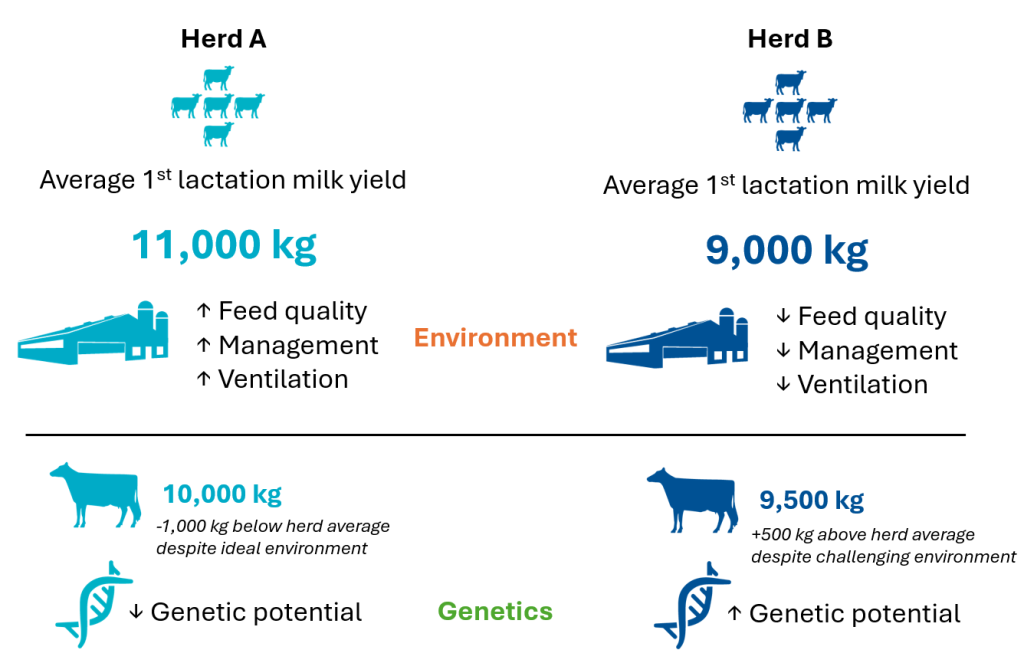
Returning to Herd A and Herd B, imagine a cow in Herd B produces 9,500 kg of milk in her first lactation. At first glance, she may appear less impressive than many cows in Herd A. However, she is performing above the average of her herd mates despite being raised in a lower-producing environment. Now consider a cow in Herd A that produces 10,000 kg of milk. While she produces more milk than the cow in Herd B, she is performing below the average of her herd mates.
After accounting for the environmental differences between the two herds, the cow in Herd B may be identified as having greater genetic potential, even though she produced less milk than the cow in Herd A. This illustrates why genetic evaluations look beyond raw performance records. The goal is to determine how much of an animal’s performance is due to genetics and how much is due to its environment.
Of course, not every influence can be measured or accounted for. Random biological variation, recording errors, and other unknown factors will always contribute to what we observe. This is why genetic evaluations use information from many animals, herds, and generations rather than relying on a single performance record.
Key Takeaways
Every phenotype reflects a combination of genetics and environment. By accounting for environmental influences, genetic evaluations can better determine how much of an animal’s performance is due to genetics, allowing for fairer comparisons among animals and better predictions of what they are likely to pass on to future generations.
In the next article, we’ll explore how the relationships between animals are used in calculating evaluations.
Authors: Hannah Sweett, Genetics Extension Expert, Lactanet Canada
Colin Lynch, Lactanet Canada
For further information, please feel free to contact Lactanet Canada staff.
Share