

How to get better with GestaLab?
Easily integrated with most on-farm reproductive management strategies, GestaLab is a cost-effective and reliable milk-based test allowing for non-invasive pregnancy testing.
This ELISA test (Enzyme-Linked Immuno Assay) is an objective, quantitative measure of Pregnancy-Associated Glycoproteins (PAGs) found in milk, which are produced by the placenta during the pregnancy. Moreover, because it is non-invasive, milk pregnancy testing improves animal welfare, reduces your workload, and is less stressful for your cows and for you.
The different ways to use GestaLab: all you need is a milk sample.
Efficient pregnancy testing is the cornerstone of great reproduction success and profitability on dairy farms. The addition of GestaLab to the reproductive toolbox becomes a logical step to support this. For those already working with GestaLab, there might be ways to optimize your use of this tool to get the most benefit from it.
Partager

Early Pregnancy check: the earliest the better
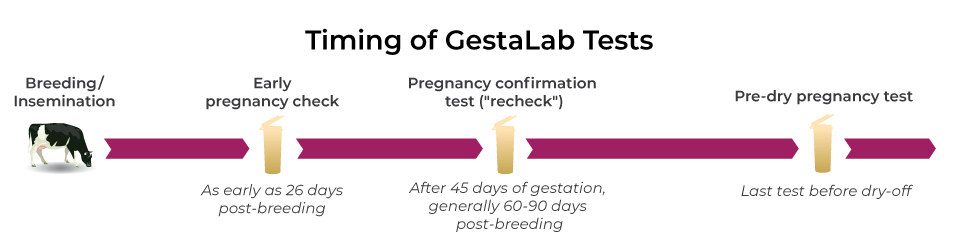
GestaLab can be used as early as 26 days post-breeding, which makes it one of the earliest accurate pregnancy testing methods available. Early pregnancy testing is essential to identify and rebreed open cows as early as possible. This allows you to improve your reproductive performance by reducing the time interval between breeding, and so improves your pregnancy rate.
Not only is GestaLab a great tool for early pregnancy testing, but it can also be a tool to predict the risk of pregnancy loss. A study on the association between the level of circulating PAGs and pregnancy losses demonstrated that the PAG value at the earliest pregnancy test (31 days post-breeding in this case) could predict which cows risk suffering pregnancy loss[1] This is precious additional information provided by GestaLab, as it not only provides a pregnancy status (open or pregnant), but also quantifies the level of circulating PAGs (PAG value).
Depending on your location, GestaLab may already offer supplemental information into the risk of pregnancy loss and the confidence of the result provided. As further studies into PAGs progress, GestaLab reports have the potential to offer more accurate predictions into the risk of pregnancy loss based on test values across Canada.
Pregnancy confirmation test: avoid unnoticed pregnancy losses
Pregnancy losses have significant economical and biological repercussions, even more so when they are not detected in a timely manner for efficient rebreeding. Early embryonic mortality, which happens shortly after breeding, accounts for many pregnancy losses (35-40%) [2] and will present as an open cow at the first pregnancy test or simply a return into heat. Late embryonic mortality, between day 28 and 42 of gestation, occurs in 5-10% of pregnancies [1,2]. This risk going unnoticed if only one pregnancy test is performed before the loss. Hence the importance of proceeding to a pregnancy confirmation test after 45 days of gestation, but generally between 60 and 90 days in gestation. Losses between day 90 of gestation and term are rare but are assuredly more detrimental.
Pre-dry pregnancy test: avoid drying an open cow
Drying-up an open cow is a very costly surprise! Late-lactation GestaLab tests, on the last DHI sample before dry-off, have gained in popularity as producers see the value in confirming the pregnancy status of a cow prior to the end of her lactation. This is especially true in the case of cows that necessitate dry treatments, as they must remain in the herd during the withdrawal period despite not being able to begin a subsequent lactation.
This is why a simple, low-cost GestaLab test at the end of lactation can be more than worth the investment in the long term!
Whether it’s to confirm early pregnancy, identify open cows in need of being re-bred, or to prevent an expensive surprise at dry-off, GestaLab has a variety of practical, low-cost applications. Consider incorporating this informative test either as a stand-alone option, or as a part of your regular milk recording routine.
With Lactanet, the choice is always yours!
Références
- Pohler KG, Pereira MHC, Lopes FR, Lawrence JC, Keisler DH, Smith MF, Vasconcelos JLM, Green JA. Circulating concentrations of bovine pregnancy-associated glycoproteins and late embryonic mortality in lactating dairy herds. J Dairy Sci. 2016 Feb;99(2):1584-1594. doi: 10.3168/jds.2015-10192. Epub 2015 Dec 17. PMID: 26709163.
- Szenci O. Recent Possibilities for the Diagnosis of Early Pregnancy and Embryonic Mortality in Dairy Cows. Animals (Basel). 2021 Jun 3;11(6):1666. doi: 10.3390/ani11061666. PMID: 34204926; PMCID: PMC8229416.