
Behind the Scenes of a Dairy Cattle Genetic Evaluation: Making Connections
Add Your Heading Text He
In the first two articles of this series, we learned that genetic evaluations begin with phenotypes and that environmental influences must be accounted for before animals can be compared fairly. We also saw that genetic evaluations rely on data from many animals, herds, and generations rather than a single performance record. But how is that information connected and shared across the population? The answer lies in the relationships that connect animals through pedigree and genomics. These connections allow information recorded on one animal to contribute to the evaluation of another. The stronger the genetic relationship, the greater the influence that information is likely to have on an animal’s evaluation.
How Relatives Contribute Information
Every animal belongs to a network of relatives linked through pedigree and, increasingly, through genomic information. These connections allow genetic evaluations to make use of information from parents, offspring, siblings, and more distant relatives, even when an individual animal has limited records of its own. A cow contributes her own performance record. Her sire contributes information through paternal half-sisters in many herds. Her dam contributes her own performance data and that of other offspring. Sons and daughters provide progeny information. More distant relatives contribute smaller amounts of information according to their expected genetic relationships. The result is a prediction that reflects all available evidence.
The influence of this information depends largely on how closely animals are related. The following example illustrates this principle, let’s assume that;
- Bull X has 400 daughters
- Bull A is the sire of Bull X
- Bull B is a first cousin of Bull X
- Bull C shares no obvious relationship with Bull X
In this scenario, we assume that Bull X is the only bull with direct performance data through his recorded daughters. Because Bull A is the sire of Bull X, if we solely consider the pedigree relationship, the two bulls share 50% of their genes. As a result, the performance of Bull X’s daughters provides meaningful indirect information for Bull A’s evaluation. If Bull X’s daughters consistently perform better or worse than average for the trait of interest, some of that signal can be attributed back to Bull A through their close genetic relationship.
Bull B, on the other hand, is more distantly related to Bull X. The expected relationship between first cousins is approximately 12.5%, meaning information from Bull X’s daughters would still contribute to Bull B’s evaluation, but much less strongly than for Bull A. The information is not ignored, but it receives less weight because the bulls share fewer genes.
Bull C, under the assumption of no obvious relationship with Bull X, would receive little indirect information from Bull X’s daughters. In practice, because bulls in the population are often related to some degree, the contribution would rarely be exactly zero, but considerably smaller than for Bulls A or B.
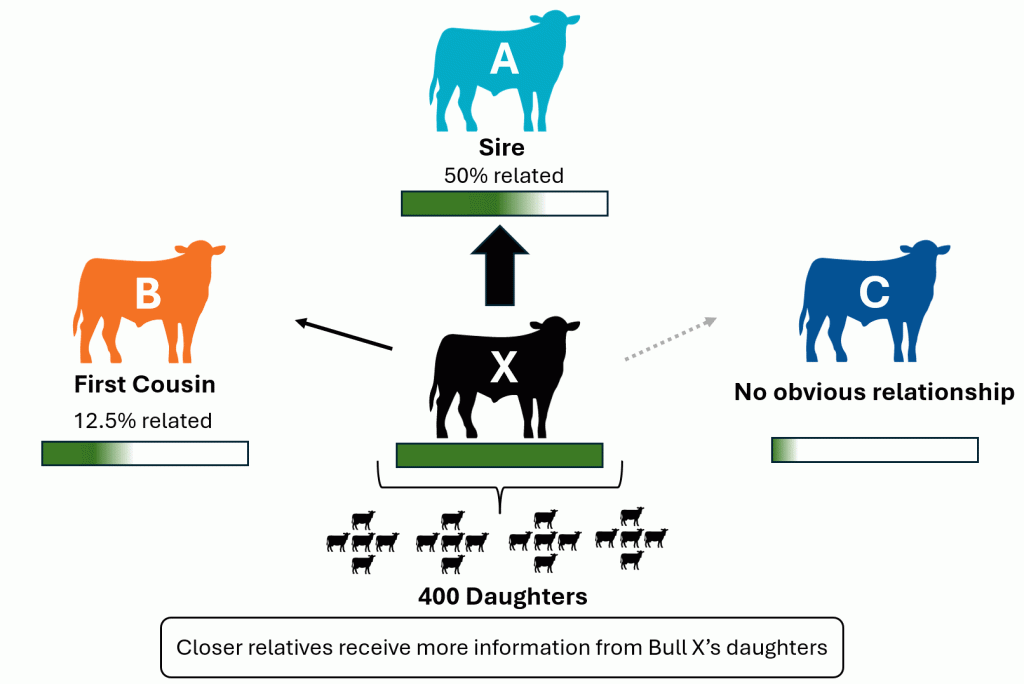
This illustrates that information collected on one animal can contribute to the evaluation of another, but the amount of influence depends on how related they are. For many years, these relationships were estimated using pedigree records. However, the actual proportion of genes inherited varies because each offspring receives a different sample of chromosomal segments from their parents. Today, genomics allows us to estimate relationships directly from DNA, providing an even more detailed picture of how animals are connected.
Improving Relationships with Genomics
Genomics transformed dairy cattle breeding by providing a more precise way to measure how animals are related. A genotype measures tens of thousands of DNA markers spread across the genome. These markers help identify segments of DNA that animals inherited from common ancestors, allowing relationships to be estimated more precisely than pedigree records alone. In other words, pedigrees estimate how much DNA two animals are expected to share, while genomics measures how much they truly share. For example, pedigree records consider all full sisters to be equally related, with an expected genetic relationship of 50%. In reality, however, the amount of DNA shared between them can vary. Genomic information can show that one pair of full sisters shares 57% of their DNA, while another pair shares 43%. As a result, the sisters may inherit different combinations of favorable and unfavorable genes affecting a trait. By capturing these differences, genomics can distinguish between animals that appear equally related on paper but differ genetically.
To predict genetic merit using genomic information, researchers must first understand how DNA is related to performance. This is done using a reference population consisting of animals with both phenotypes and genotypes. By studying these animals, genetic evaluation systems learn which genomic patterns are associated with superior or inferior performance for a trait. These associations can then be used to predict the genetic merit of young animals before they have their own records or large numbers of offspring. This has been one of the major benefits of genomics, as it provides much more accurate genetic predictions earlier in an animal’s life, allowing selection decisions to be made at a younger age. As a result, the generation interval has been substantially reduced, particularly on the sire side, helping increase the rate of genetic improvement.
Key Takeaways
Whether the information comes from an animal’s own records, its relatives, or its DNA, genetic evaluations enable the use of all available information to predict genetic merit as accurately as possible. Genetic evaluations work because related animals share genes, allowing information collected on one animal to improve the evaluation of another. Pedigree information provides the foundation for these connections, while genomics measures them more precisely.
In the next article, we will explore how all available information is used to produce the best possible prediction while considering heritability, reliability and shrinkage.
Authors: Hannah Sweett, Genetics Extension Expert, Lactanet Canada
Colin Lynch, Lactanet Canada
For further information, please feel free to contact Lactanet Canada staff.
Share